

What competencies separate elite medical, pharma and biotech leaders from the rest – and how you can develop them

Leaders in Medical, Pharma, and Biotech are navigating one of the most turbulent environments in recent memory. A steep patent cliff is putting an estimated $275 billion in revenue at risk from loss of exclusivity among the top 15 companies alone, while new US tariffs on branded products and the expanding impacts of drug pricing reform are current realities – not distant threats. Geopolitical uncertainty has more than doubled as a concern among biotech leaders since 2023, jumping from 26% to 53%, and two-thirds of leaders now cite shifting regulatory requirements as a significant operational challenge. At the same time, funding is becoming increasingly concentrated in fewer but larger deals, leaving the majority of organisations competing harder than ever to secure resources – all while the National Institutes of Health has cut funding by nearly 40%.
The structural pressures on the sector are compounded by an increasingly complex web of organisational relationships. For emerging biotech and life science companies bringing a first product to market, the challenge is particularly acute: leaders must simultaneously build capability across every world region while entering joint ventures with larger partners who bring scale but also impose their own cultures, priorities, and ways of working. The asymmetry of those relationships – and the speed at which leaders must navigate them – has no equivalent in most other industries. And it is not only the smaller players facing this dynamic: large life science organisations increasingly partner with each other, bringing together two established but potentially disparate cultures under a single strategic objective, where the collision of legacy ways of working can be just as disruptive as any scientific uncertainty.
A related and often underestimated challenge is the one playing out inside organisations themselves. Whether the trigger is a label change, a new launch, or a significant regulatory shift, leaders are routinely required to bring together what practitioners in the field sometimes call the "Holy Trinity" – and on a bad day, the "unholy trinity" – of Medical Affairs, Marketing, and Market Access. These three functions sit at the heart of commercial execution, yet they operate with different imperatives, different vocabularies, and often competing definitions of success. The gravitational pull towards silos and fiefdoms is strong. Extraordinary leaders understand that aligning these functions is not a coordination task – it is a strategic one, requiring deliberate effort to build shared purpose, shared language, and genuine trust across boundaries that have historically been porous at best.
The culture dimension extends further still. Many of the largest life science organisations have moved aggressively into incubator and accelerator models, providing funding and infrastructure to biotech startups in exchange for access to early-stage science and future pipeline options. The leadership challenge embedded in these arrangements is frequently overlooked: the culture of an established pharmaceutical company – process-driven, compliance-oriented, built for scale – sits in direct tension with the scrappy, fast-moving, high-tolerance-for-ambiguity culture of a biotech startup. Managing that interface productively requires a particular kind of leader: one who can hold both worlds with respect, resist the urge to impose, and find the conditions under which innovation can genuinely flourish rather than being slowly absorbed into the mothership.
Beyond the financial and regulatory headwinds, leaders face profound pressure to transform how their organisations operate. In 2026, the most forward-looking companies are beginning to reinvent how discovery happens – embedding AI, automation, and digital tools into every layer of the enterprise to accelerate work and reshape the R&D model. Yet technology alone won't carry the day. Despite advances in science, more than half of industry leaders believe progress is lagging expectations, and nearly three-quarters acknowledge that trial designs are more complex than necessary – yet many still rely on that complexity to meet their objectives.
For leaders in this sector, the defining challenge of 2026 is therefore not only scientific or financial – it is the ability to align organisations that were never designed to work together, build trust across functions with competing priorities, and create cultures agile enough to keep pace with a rapidly shifting landscape. That is an extraordinarily high bar. The data, however, tells us clearly what separates the leaders who clear it from those who do not.
Over more than three decades, Zenger Folkman has assessed leadership effectiveness across thousands of medical, pharma and biotech leaders. In this study, we examined 2,223 leaders in the medical, pharma and biotech industry, then selected 194 top management leaders, each evaluated by an average of 14 raters across 60 distinct leadership behaviours using our validated 360-degree assessment methodology. We segmented the population into quartiles, comparing the lowest-rated leaders against the highest-rated.
The difference was striking – top-quartile leaders didn't outscore their bottom-quartile counterparts by a modest margin. They operated at a categorically different level.
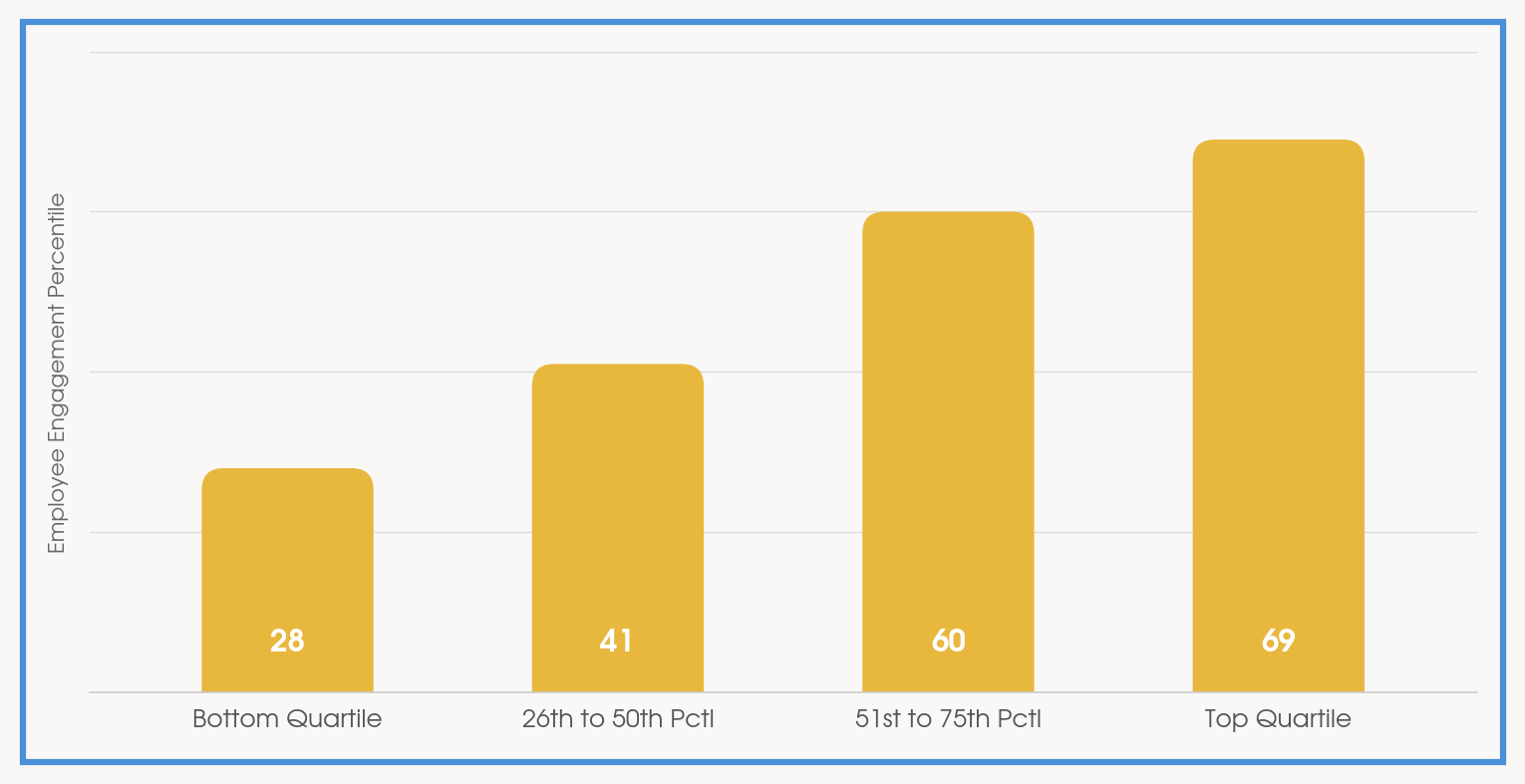
The most tangible impact of leadership quality shows up in employee engagement. Our research revealed a stark gap: direct reports of bottom-quartile leaders scored at only the 28th percentile for engagement, while direct reports of top-quartile leaders scored at the 69th percentile. That 41-percentile difference is not an abstract HR metric – employees feel it immediately.
Research indicates that employees with leaders in the bottom quartile have only 18% that are highly satisfied with the organisation, and 45% are considered a retention risk. Low engagement isn't simply a people problem – it's a performance and risk management problem. In a sector where cross-functional alignment, joint venture execution, and the bridge between established players and startup cultures are all leadership-dependent, the stakes compound quickly. When the leader of a commercial function fails to create genuine cooperation across Medical Affairs, Marketing, and Market Access, when a joint venture team splinters along cultural fault lines, or when a biotech incubatee disengages from its sponsor's priorities – the consequences register not just on the team, but on the pipeline, the launch, and ultimately the patient.
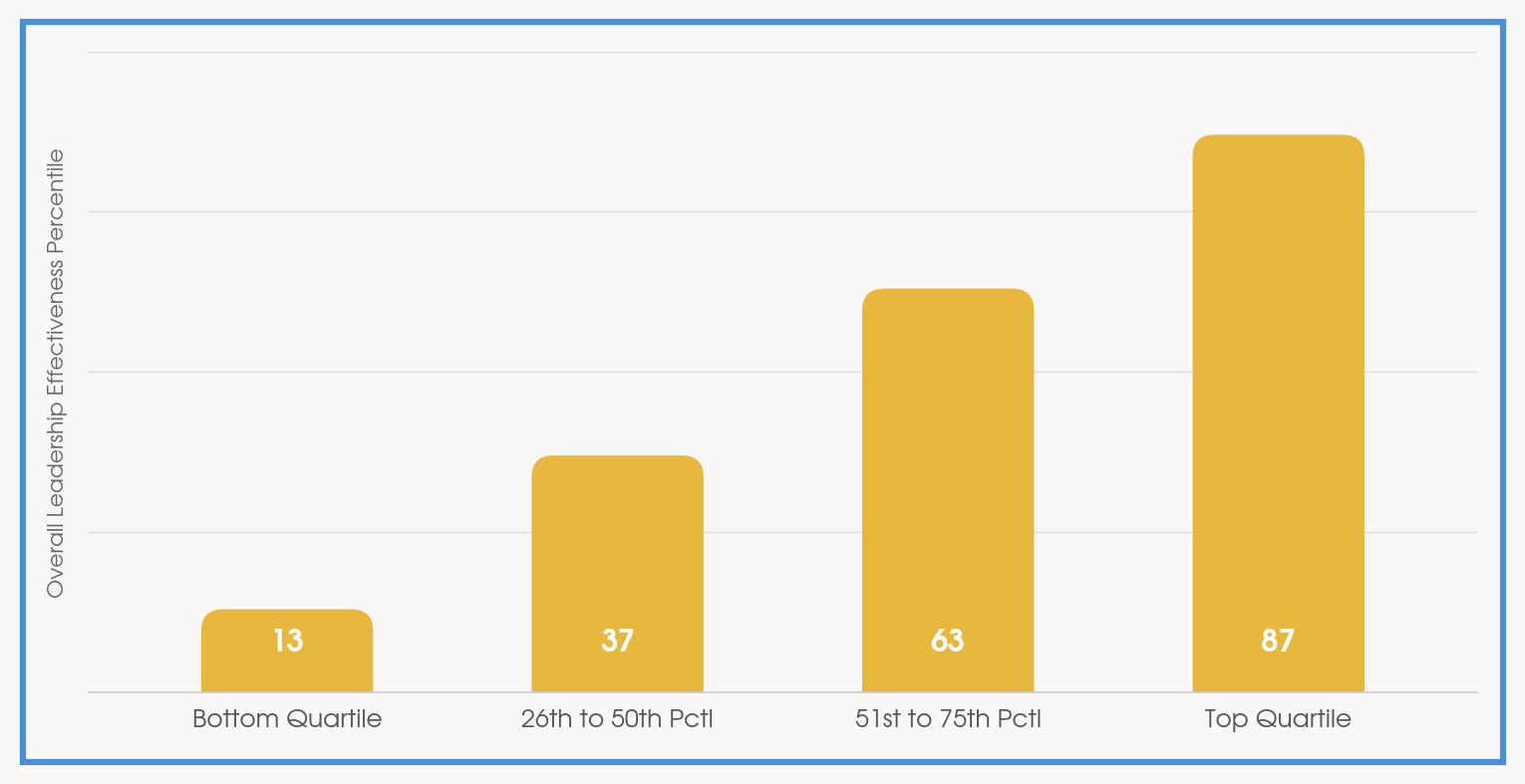
Nine competencies emerged with the greatest consistency in separating top-quartile leaders from the bottom. Critically, these are not innate traits – they are learnable, measurable behaviours.
1. Solves Problems and Analyses Issue
Top leaders are trusted for their sound judgment and are capable of cutting through complexity to reach clear, well-reasoned decisions. They identify emerging trends, risks, and opportunities early – giving their organisations a proactive edge in a fast-moving environment.
2. Communicates Powerfully and Prolifically
The best leaders communicate with clarity, conviction, and consistency. They give their teams a genuine sense of direction and purpose, and they translate complex insights into messages that resonate – creating alignment and shared understanding across the organisation.
3. Establishes Stretch Goals
Exceptional leaders raise the bar. They challenge their teams to pursue outcomes that go beyond what they initially believed achievable, keeping people focused on the highest-priority work and setting standards of excellence that drive meaningful progress.
4. Displays High Integrity and Honesty
The most effective leaders model the behaviours they expect from others. They are consistent, transparent, and trustworthy – building credibility by honouring their commitments and ensuring their actions align with their words.
5. Makes Decisions
In a sector defined by uncertainty and urgency, the ability to make timely, well-grounded decisions is a critical differentiator. Top leaders act decisively under pressure and maintain forward momentum even as conditions continue to shift.
6. Develops Strategic Perspective
Great leaders help their teams connect day-to-day work to broader organisational goals. They maintain a clear line of sight between vision and execution – enabling people to see how their contributions matter and to translate strategic intent into meaningful, challenging objectives.
7. Champions Change
Top leaders recognise when the organisation needs to change course and they have the courage to drive that change – even when it is difficult. They communicate the rationale compellingly and build energy and commitment around new initiatives and directions.
8. Collaboration and Teamwork
The best leaders break down silos and build genuine cooperation – both within their teams and across the broader organisation. They create environments where people work interdependently towards shared goals, generating results that no individual or group could achieve alone.
9. Inspires and Motivates Others to High Performance
Top-quartile leaders energise the people around them. They foster a culture of continuous improvement in which individuals and teams are motivated to push beyond expected results, channelling personal and collective effort towards exceptional outcomes.
The data is unambiguous: leadership quality is the single most controllable variable in medical, pharma and biotech performance. Technology, facilities, and commercial investment all matter – but none generate their full return without effective leaders directing the teams that serve customers every day. And in a sector facing the specific pressures outlined at the start of this paper – loss of exclusivity, first-to-market complexity, cross-cultural joint ventures, internal functional fragmentation, and the challenge of bridging established players with startup cultures – the quality of leadership is not a background variable. It is the deciding one.
What makes this finding both sobering and hopeful is that leadership skills are not fixed. Zenger Folkman's three decades of research confirm that leaders can – and do – move from the bottom quartile to the top with the right development process. But that doesn't happen through good intentions or annual reviews. It requires a deliberate, sustained commitment to leadership development treated as a core organisational priority.
That process begins with honest 360-degree assessment. Most leaders carry meaningful blind spots about their behaviour and its impact on others. A rigorous 360 provides a mirror that reflects not the leader's self-perception, but the actual experience of the people who work with them every day. Without that data, development is guesswork.
With it, development becomes focused and intentional – targeting the specific behaviours that will move the needle most on each leader's effectiveness and their team's engagement, rather than delivering broad, generic training that produces little lasting change.
The returns compound across every dimension of organisational performance: higher engagement drives better customer satisfaction; reduced turnover preserves institutional knowledge and lowers recruiting costs; aligned teams execute more consistently; and a genuine culture of development attracts stronger talent at every level – building competitive differentiation that cannot simply be purchased or replicated.
The nine competencies in this research are a practical, evidence-based blueprint for what the best medical, pharma and biotech leaders actually do – and they map directly onto the demands the sector now places on its people. Leaders who solve problems and analyse issues with rigour are better equipped to navigate loss of exclusivity without losing strategic nerve. Leaders who champion change and communicate powerfully are the ones who can bring Medical Affairs, Marketing, and Market Access into genuine alignment rather than uneasy coexistence. Leaders who collaborate across boundaries – and inspire others to do the same – are the ones who make joint ventures work and who earn the trust of the biotech founders they are trying to partner with, not absorb. The question is not whether leadership development matters in this environment. The data answers that definitively. The question is whether your organisation will treat it with the urgency the moment deserves.
Joe is Co-Founder of Zenger Folkman. A globally renowned psychometrician, heholds a doctorate degree in Social and Organizational Psychology, and a master's degree in Organizational Behaviour from Brigham Young University. He is a best-selling author or co-author of nine books on leadership and feedback.
Jonathan is a certified trainer of NLP, a Certified Master Coach, a Certified Zenger Folkman Extraordinary leader facilitator as well as qualified in organisational change from Geert Hofstede’s ITIM organisation. He is also one of the UK’s few Zenger Folkman Extraordinary Leader Master Trainers.
